Context & Engineering Objective
This individual ME 6105 project asked a practical design question: how thin could an aluminum heat-sink fin be made before uncertainty in the operating environment made the design thermally unsafe? A conventional deterministic optimization would evaluate one nominal heat load and one ambient temperature. That approach can produce a light design, but it does not quantify how frequently the design will violate its thermal limit when those inputs change.
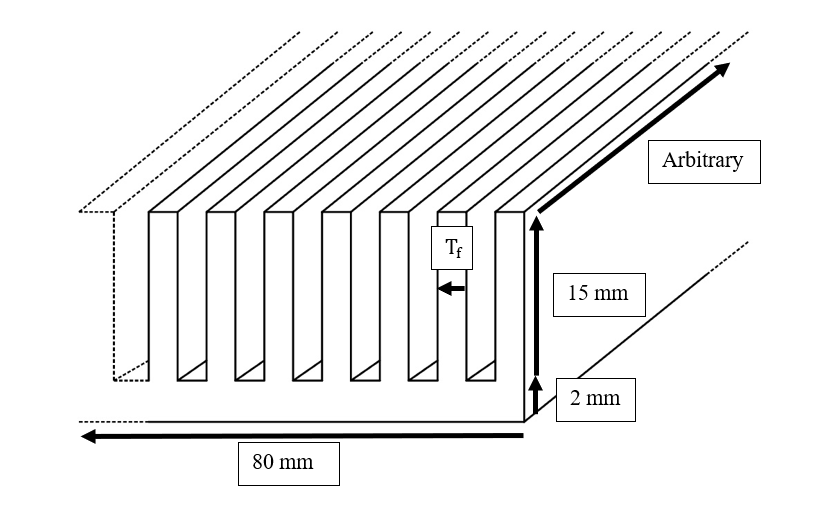
I formulated the problem as a surrogate-assisted Reliability-Based Design Optimization (RBDO). Fin thickness controlled the mass objective, while heat flux and ambient temperature represented uncertain operating conditions. The design had to preserve at least 0.60 mm between adjacent fins and satisfy a probabilistic constraint on maximum temperature: no more than 129.3 °C with 99% probability of success.
Role & Project Scope
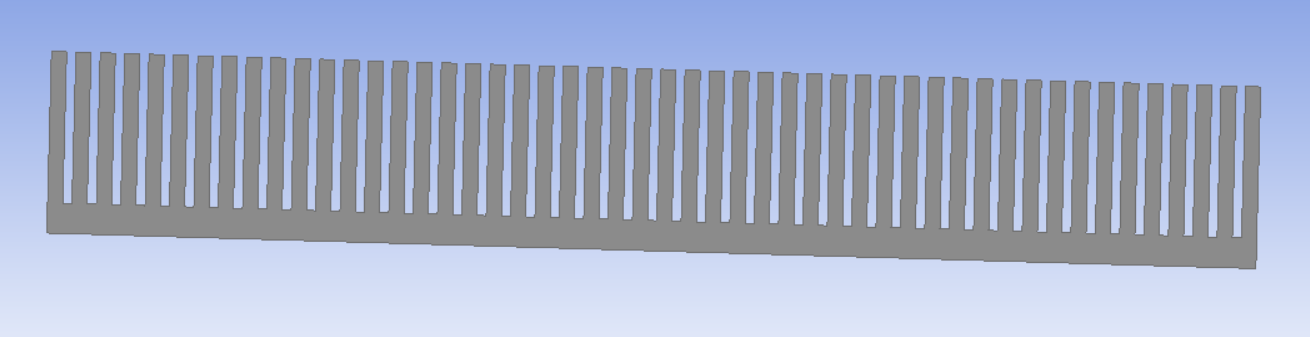
I built the full computational workflow: parameterized thermal simulations, sampling strategy, surrogate model, reliability calculation, and constrained search. The study used a two-dimensional, unit-depth heat-sink representation rather than claiming a production-ready three-dimensional cooler. Its purpose was to demonstrate a defensible decision process under uncertainty and to quantify where a deterministic minimum-mass choice breaks down.
- Represent heat flux from 25,000 to 120,000 W/m² and normally distributed ambient temperature
- Search a 0.10–1.58 mm fin-thickness range while preserving at least 0.60 mm fin spacing
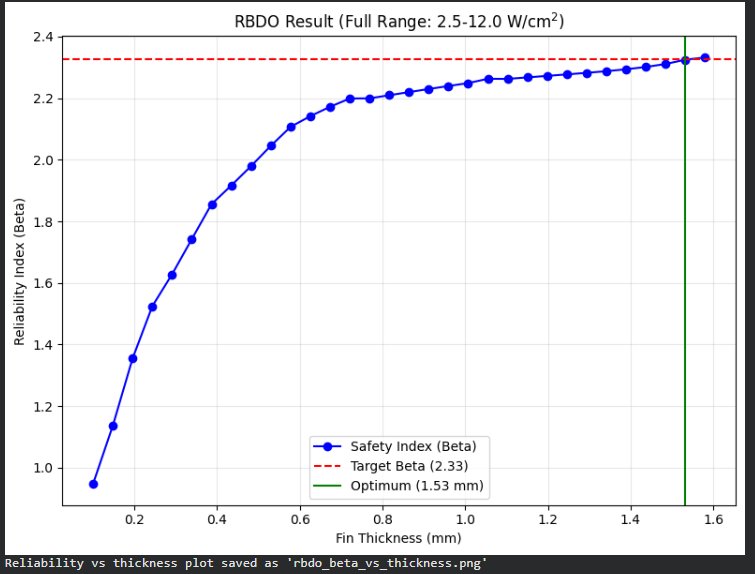
- Enforce a reliability index of β ≥ 2.326, corresponding to 99% probability of success
- Retain high-fidelity ANSYS physics without placing the full model inside every optimization iteration
Methodology
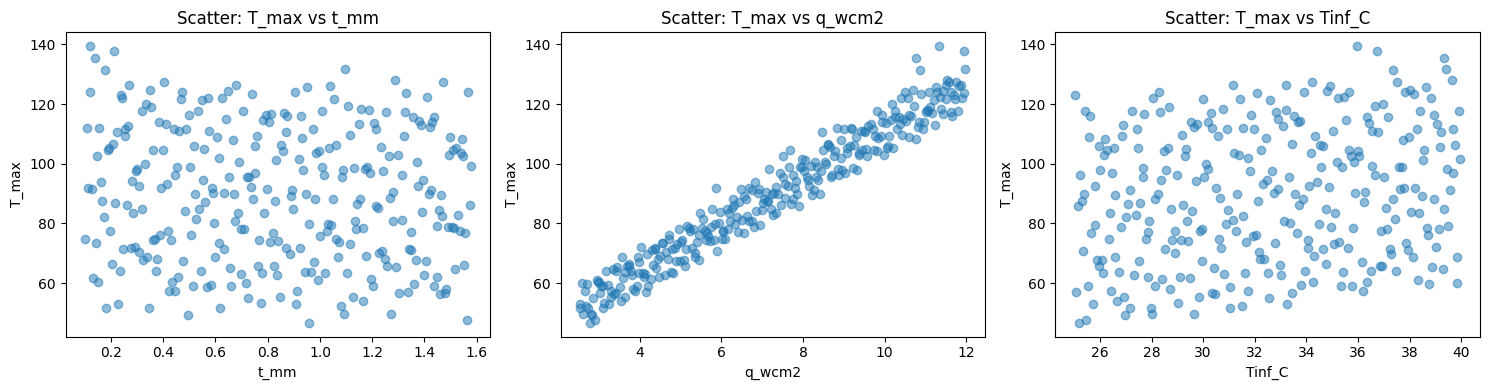
The workflow separated expensive physics generation from repeated probabilistic evaluation. I generated 300 Latin Hypercube samples across the thickness, heat-flux, and ambient-temperature space, using a space-filling design so the surrogate would see the full operating envelope rather than clusters of redundant points. Each sample was evaluated with a steady-state thermal model in ANSYS.
- Ran two-dimensional ANSYS steady-state thermal simulations using an approximately 30,000-element quadrilateral mesh
- Trained a standardized 3–24–24–1 MLP with ReLU activation and the L-BFGS optimizer
- Used FORM with the Hasofer-Lind-Rackwitz-Fiessler algorithm to locate the most probable failure point
- Applied Brent root-finding to identify the minimum fin thickness that met the target reliability
Once trained, the surrogate replaced ANSYS inside the nested reliability loop. FORM mapped the physical uncertainties into standard-normal space, while HL-RF searched for the most probable failure point. That reliability index then became the constraint evaluated by the outer Brent search.
Engineering Decisions & Trade-Offs
The key architectural decision was not to place the finite-element solver inside every reliability iteration. Direct coupling would have repeated thousands of otherwise identical mesh and solution operations. The surrogate retained the thermal response learned from ANSYS while making the repeated most-probable-point calculations computationally practical.
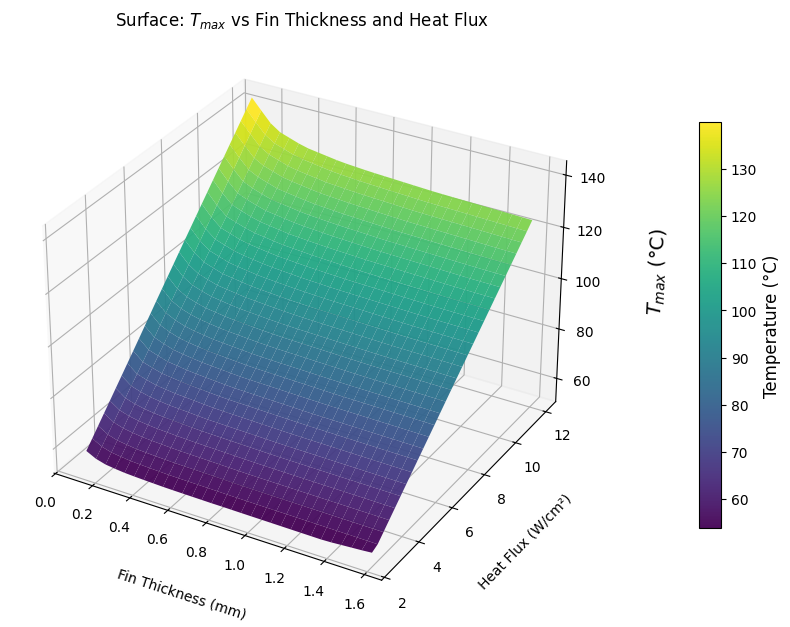
Standardizing all three inputs was equally important because thickness, heat flux, and temperature have very different numerical scales. A compact network and L-BFGS optimizer were selected for this small, smooth regression problem instead of a deeper model that would add tuning cost without adding useful physics. The final sensitivity results also exposed a limitation of the design space: heat flux dominated the response, while fin thickness had relatively weak leverage. That finding motivates future work with fin height, count, material, or topology as additional design variables.
Results & Validation
Modeled result The final design used 1.5431 mm fins and had a mass of 2.5152 kg per unit depth. Its reliability index was 2.3264, meeting the 99% probability target at the minimum feasible mass. After the ANSYS dataset had been generated and the surrogate trained, the complete RBDO search ran in under five seconds.
At the 12 W/cm² comparison condition, the reliability-based design predicted 124.57 °C and passed the 129.30 °C limit. The 0.10 mm deterministic design predicted 143.72 °C and failed. This side-by-side comparison is the project’s most consequential result: minimizing geometry at a nominal condition selected a design that could not tolerate the upper end of the modeled operating range.
The network achieved an R² of 0.99999 and an RMSE below 0.5 °C on the 300 simulation points used to fit it. Because the project did not define a separate held-out validation set, I treat those values as evidence of close training-data agreement—not proof of unrestricted generalization beyond the sampled domain.
Impact, Limitations & Next Steps
The project’s impact is methodological rather than a claim about a manufactured heat sink. It demonstrates a reusable way to couple high-fidelity physics with reliability analysis and shows how uncertainty can reverse a seemingly attractive mass decision. It also makes the design logic inspectable: the reliability target, most probable failure point, and deterministic comparison can all be traced to explicit inputs.
The conclusions remain bounded by a two-dimensional unit-depth model, one geometric design variable, prescribed uncertainty distributions, and training-domain validation. A stronger next study would add multiple geometric variables, reserve a true held-out simulation set, and use adaptive sampling near the limit-state boundary. Multi-fidelity models or topology optimization could then expand the design space without returning to a prohibitively expensive direct-simulation loop.